Showing posts with label Israel a Nation in Trouble. Show all posts

Monday, March 12, 2012

The Distractions From Gaza


Rocket Launch From Gaza


Benjamin Netanyahu
Benjamin Netanyahu says his military is prepared to "broaden operations" if Palestinians continue to fire rockets from Gaza.

As violence between Gaza militants and Israel continue for the fourth day, Israel's military "is ready to broaden its operations and will continue to act as necessary," Netanyahu said today, without elaborating.

The current violence erupted Friday, when Israel killed the leader of a Palestinian militant group in an airstrike. Gaza militants have since fired more than 200 rockets at cities in southern Israel, where 1 million Israelis live, disrupting life there.
Gen. Yoav Mordechai

Chief military spokesman Brig. Gen. Yoav Mordechai said Israel would halt its raids if the rocket fire stopped, but added that the Israeli military would continue to take pre-emptive action to foil militant attack plans.

Israel launched Friday's initial airstrike to stop a militant group's plan to infiltrate into Israel through Egypt's Sinai peninsula. In the past, similar flare-ups have died out by themselves or with informal cease-fires negotiated by third parties, often Egypt.

In this case too, Egypt has been trying to mediate an end to the clashes, and Hamas has also appealed to other Mideast countries to join the truce attempts. But by Monday afternoon, there was no sign of progress.

Israeli aircraft swooped down on Gaza 11 times by midday, striking what the military said were rocket-launching sites and a weapons storage facility. Two militants, a 16-year-old high school student, and a 65-year-old man and his 30-year-old daughter were killed in four separate raids, Gaza health official Adham Abu Salmia said.

One of the militants was killed while riding a motorcycle. The teenager died while walking to school, and the father and daughter were killed when a missile struck right outside their home, witnesses said.

A senior IDF intelligence officer said that Monday's rocket fire escalation is part of Islamic Jihad's attempt to end the current round of fighting with a success.
Mahmoud Zahar

Hamas leader Mahmoud Zahar said while a truce is likely soon, the timing depends on Israel.

"I expect matters will calm down," Zahar said in Cairo. "The statements coming from them (Israel) either in public or via mediators, especially Egypt, say that they do not want escalation."

Asked how long it would take, Zahar said he did not know but it would depend on Israel, which he blamed for setting off the latest round of violence by killing Palestinian leaders on Friday.


Zahar's comments came as representatives from Islamic Jihad and the Popular Resistance Committees (PRC) said that they oppose signing a ceasefire with Israel, "We will not agree on a ceasefire stipulated by Israel, neither do we accept a ceasefire while the lives of our people are taken without restraint, an Islamic jihad official was quoted as saying.


A senior IDF intelligence officer said that Islamic Jihad was currently focused on "saving face" and creating a "victory image" with which it will be able to claim that it defeated the IDF.

In reality though, the Islamic Jihad has suffered heavy losses throughout the four days of fighting including close to 20 dead operatives as well as extensive damage to its terrorist infrastructure.


According to the officer, Hamas was mostly "sitting on the sidelines" and was not actively participating in the rocket attacks against Israel. On the other hand, Hamas, the officer said, was also not working to prevent the rocket fire.
"It is possible for this round to end soon if Hamas and the Egyptians step up their involvement in influencing Islamic Jihad," the officer said.

According to the IDF, over 200 rockets have been fired into Israel since Friday including 50 with ranges of over 29 kilometers. On Monday, a rocket landed near Gedera, the farthest north a projectile was fired since the beginning of hostilities on Friday. The officer said that some of the rockets fired into Israel were manufactured domestically in the Gaza Strip.
Gen. Doron Gavish

The vast majority of the rockets shot at Israeli cities were intercepted," said Brig. Gen. Doron Gavish, commander of the defense unit that includes Iron Dome. "This is a new era in military history, there is an effective defense against rockets."

Although military officials are quick to note that Iron Dome will not offer hermetic protection, its success rate raised hopes the military has found a way to rob militants of their most potent weapon — primitive, short-range rockets that have made life miserable for hundreds of thousands of Israelis by eluding their high-tech military for years.

Israeli Foreign Minister Avigdor Lieberman warned Monday that the continued fire from Gaza "buries any chance of a territorial link between Gaza and the West Bank." The Palestinians want both areas, which lie on opposite sides of Israel, for a future state, along with Israeli-occupied east Jerusalem.


Gaza and the West Bank are today ruled by dueling governments. Hamas is internationally shunned because of its refusal to renounce violence against Israel, and Israel's peace talks with the West Bank government of Palestinian President Mahmoud Abbas stalled years ago.
Foreign Minister Avigdor Lieberman

Although the current fighting shows no signs of subsiding soon, both Hamas and Israel seem eager to avoid the kind of all-out war they waged three years ago.

As it has done since that conflict, Hamas has stayed out of the current clashes for fear of provoking a harsh Israeli retaliation. But that has not stopped other, smaller Gaza factions from attacking Israel, and Israel continues to hold Hamas ultimately responsible for any violence emanating from Gaza.

Tuesday, September 13, 2011

Turkey ups the antee against Israel


Turkish F-16


Turkey has developed a new identification system for its U.S.-made F-16 fighter jets, which will now allow them to fire at Israeli targets, a Turkish newspaper as reporting on Tuesday. According to the report, the new technology will allow Turkey to identify its enemies itself, as opposed to the old U.S. system which automatically identified all Israeli targets as a "friend," preventing Turkish fighter jets from firing at them, even when Turkish pilots were ordered to do so. 
Prime Minister Recep Tayyip Erdogan

The new Identification “Friend or Foe” will be put into place on all Turkish fighter jets and military vessels. The orders to modify the system reportedly came directly from Turkish Prime Minister Recep Tayyip Erdogan's office. The new radar system – Identification Friend or Foe (IFF) – is a defensive command and control system developed by Turkey's Military Electronics Industry (ASELSAN) for the nation's air force and navy. It is slated to replace a similar US version which is in use today.

The US system is comprised of lists of "friends" and "foes." The system's settings are designed to prevent pilot error as well, to an extent, disabling the ability to fire at "friendly" targets even by mistake.

The move, whose timing coincides with a prolonged period of unprecedented diplomatic tensions between Ankara and Jerusalem, has received extensive media coverage in Iran, as well. According to foreign media sources, the Israeli Air Force has a fleet of 1,964 aircraft, including 689 advanced assault helicopters and F-15 and F-16 fighter jets. And Israel's aerial superiority will soon receive a significant boost, in the form of the US-made F-35 fighter jet. 
F-35 Joint Strike Fighter

The Turkish Air Force is said to have a fleet of "just" 1,940 aircrafts, including F-16s and F-4 Phantoms, as well as 874 assault helicopters.

Like Israel, Turkey has also been promised the F-35. It is slated to receive it by 2015.

The move comes at the height of the Israeli-Turkish diplomatic crisis, after Ankara expelled the Israeli ambassador in a feud over an Israeli raid last year that killed nine Turks on a flotilla bound for the Palestinian enclave of Gaza. Israel has said it would not apologize, which Turkey has demanded.

Turkish Prime Minister Recep Tayyep Erdogan has demanded Israel apologizes, and recently embarked on a visit to Egypt in an attempt to re-establish diplomatic and military ties with Cairo.

In part of the interview published by Al-Shorouk, an Egyptian daily, on Monday, Erdogan said Israel had "not fully grasped the reality of changes that happened in the Arab world."

Last week, Erdogan warned that the Turkish navy will strengthen its presence in the eastern Mediterranean Sea, and that Turkish warships will accompany any aid vessels wishing to transfer aid to the Palestinians in the Gaza Strip.

Thursday, August 18, 2011

Israel Determined To Protect Its Sovereignty


Suicide attack in Israel


Seven Israelis were killed in a string of coordinated attacks in southern Israel on today which Israel said were carried out by militants from Gaza and warned it would hit back hard.

The Israeli army said two attacks had taken place on route 12, a desert road next to the Egyptian border, near the Red Sea resort town of Eilat.

In the first incident, gunmen strafed a bus. In the second, an improvised explosive device detonated when a military vehicle carrying Israeli troops drove over it.

Security sources revealed a third incident on another desert road near the Jordanian border, in which an RPG was fired at a car near Beer Ora, some 15 kilometers (nine miles) north of Eilat.

Medics said all seven victims died in that attack, at least four of whom were traveling in the same car, with reports also suggesting there was mortar fire in the same area.

An Israeli army spokeswoman described the incidents as a 'combined terrorist attack' and said at least nine people were injured when gunmen ambushed bus #392 as it drove south along route 12. Shortly afterwards, 'several people were injured as a result of an explosive device detonated at an Israel Defense Force vehicle that had arrived at the scene and drove over it', she said.

Anti-tank missile fired
There were also unconfirmed reports that an anti-tank missile had been fired into Israel from across the border in Egypt.

Security sources initially said that gunmen in a car had opened fire a bus, and suggested the attackers may have fired from the Egyptian side of the border. But the Israeli army later said 'everything took place in Israeli territory'.

The bloodshed sparked a massive manhunt for the killers and at one stage Israeli troops staged a running gun battle with the militants, which left seven of the gunmen dead, security sources said.

However, troops maintained a lockdown on the area as they scoured the region for any others who had managed to flee.

There was no immediate information about the identity of the attackers, although one senior Israeli source said they had infiltrated from Egypt.


As the hunt continued, the Israeli government pointed the finger at the Gaza Strip, saying they had concrete information showing the killers came from there.
Defense Minister Barak


"The source of the terror incidents is Gaza and we will act against them with all our strength and determination," Defense Minister Ehud Barak said in a statement, in which he also criticized Egypt's hold on the Sinai Peninsula.

"This is a very serious terror incident at a number of locations. The incident reflects the weakness of the Egyptian hold on Sinai and the expansion of activity there by terror elements," he said.

Israeli Prime Minister Benjamin Netanyahu called the attacks 'very serious' in a statement released by his office.
Prime Minister Netanyahu

"We are talking about a very serious incident in which Israelis were hurt and Israel's sovereignty was damaged," he said.

Netanyahu's spokesman Mark Regev said Israel had 'concrete information' the attackers had come from Gaza.

"We have specific and concrete information that these terrorists who killed Israelis today came from the Gaza Strip," he told AFP.

"This is not speculation. This is evaluation; this is analysis; this is concrete information."

Another Israeli official, speaking on condition of anonymity, said the attackers had entered Israel from Sinai which they had cross into from Gaza.

In light of the bloodshed in the south, Israel issued a travel warning urging its citizens in Sinai to return home immediately.

But Egyptian security sources denied that Palestinian militants had slipped past their patrols into Israel, and the governor of northern Sinai challenged Israel to provide evidence that the attacks originated from Egypt.

Wednesday, June 8, 2011

Israel, Hamas close to reaching Shalit deal


 Gilad Shalit
Prisoner exchange talks between Israel and Hamas, geared at the release of abducted Israel Defense Forces soldier Gilad Shalit, were near their fruition, the Palestinian envoy to Russia said. 

The comment by Fayed Mustafa, quoted by Russian news agency RIA Novosti, came after Egypt's former ambassador to Israel ignited a rumor frenzy after he was cited in the Al Masry Al Youm newspaper as saying that the Shalit deal was just hours away.

Later Thursday the Prime Minister's Office denied that there were any significant progress in Shalit talks, a claim that was seconded by an Egyptian official speaking to Haaretz.

However, speaking with the Russian news agency RIA Novosti, Palestinian envoy to Russia Fayed Mustafa said that "negotiations between Israel and Hamas, ongoing in Cairo with Egyptian mediation, are close to completion."

The RIA report stated that the Palestinian official provided no further information.
Ahmed al-Jabari

Meanwhile, the official Hamas website reported on Thursday that the head of the groups' military wing Ahmed al-Jabari has been in Cairo for several days to try and promote a Shalit prisoner exchange deal.

That report joins other Palestinian reports on Wednesday, according to which Amos Gilad, who heads the diplomatic security bureau of the Defense Ministry, has also traveled to Cairo in recent days.
Prime Minister Benjamin Netanyahu

However, a Hamas official quoted by the group's website denied that a deal with Israel was close, blaming the government of Prime Minister Benjamin Netanyahu of delaying an agreement.

This isn't the first time Hamas and Israeli officials were reported to have been in Cairo at the same time, with the last time being 2009. Then, reports claimed that Jabari arrived in the Egyptian capital for Shalit talks, as well as then Shin Bet chief Yuval Diskin and Shalit talks envoy Ofer Dekel.

Speaking on the Shalit affair on Wednesday, Home Front Defense Minister Matan Vilnai said that even the leaders of Hamas do not know Shalit's whereabouts, adding that only a small group of militants were aware of where the IDF soldier was being held. 
Prime Minister Ismail Haniyeh


"Hamas Prime Minister Ismail Haniyeh does not know where Shalit is and the Hamas chief of staff does not know either," Vilani said, in an address delivered just three weeks before the fifth anniversary of Shalit's abduction in a cross-border raid from the Gaza Strip.

"There is a very small group of people who are holding Gilad Shalit that know [where he is being held], and a large number of them are no longer with us," said Vilnai.

Tuesday, June 7, 2011

Wanted: A pro-Israel leader


Rabbi Richard Jacobs
The nomination of Rabbi Richard Jacobs as president of Reform Movement will hurt those Reform congregants who care most about the Jewish state.

This month, the Reform Movement is poised to throw away decades as part of mainstream Zionism by its short-sighted appointment of Rabbi Richard Jacobs as president. Jacobs has promised to improve Reform fundraising and congregation building. The board has ignored his activism on Israel – activism which focuses on Israel as a human rights abuser and occupier.

News of the Jacobs appointment spread through the internet – a Facebook revolution in the grey-haired set of Reform congregants. They put their names on an ad asking their leaders to choose a more mainstream candidate. The ad read: “We are Reform Jews Who Want the Reform Movement to Stand with Israel. The Union for Reform Judaism’s nominee for president, Rabbi Richard Jacobs, does not represent the pro-Israel policies cherished by Reform and American Jews. He does not represent us.”

The message is simple. The presidency of Rabbi Jacobs will hurt those Reform congregants who care most about Israel.
Rabbi David Ellenson

Rabbi David Ellenson, president of Reform’s rabbinic college (HUC-JIR), recently said: “The ad was... the most despicable thing I’ve ever encountered in my life in the Jewish community. This brings great shame to the Jewish community... they fail to reflect on the humanity and integrity of people who have different views.”

Jacobs is openly to the left of mainstream Reform. He says so himself; he is an Israel activist of the sort that makes other Jews’ heads explode. No declarations of how much he loves Israel will change that.

What is mainstream for Reform? In many congregations, there are members of AIPAC and Hadassah that believe Israel is a decent and admirable country. They want a Reform leader who understands Israel’s outstanding moral record, as past president Rabbi Eric Yoffie did.
Rabbi Eric Yoffie


They respected Rabbi Yoffie’s words of leadership, said during an address to the J Street Convention in 2009: “Reject the trap of false moral equivalence, and to never, ever, express contempt for the state and its people. And... avoid like the plague the self-haters in the Jewish community who defend the rights of every group except their own.”

In most congregations, “mainstream” is being worried over Iran, and feeling sickened by the anti-Semitism prevalent in the Palestinian Authority. Unlike J Street, they're grateful that Congress respects and supports Israel.

They support the written guidelines of the Reform movement: “Oppose efforts to demonize and delegitimize Israel and its leaders in domestic and international forums; commend the governments of the United States and Canada for their continued and unconditional support of Israel; Help end the Iranian nuclear threat.”

Rabbi Jacobs shares none of these emotions. He defended the New Israel Fund’s promotion of the Goldstone Report, which falsely accused Israel of war crimes during Operation Cast Lead. He serves on the rabbinic board of J Street which, several months ago, called on Obama to allow a UN resolution condeming settlements to go through by not using the veto. Jacobs also intimates support for boycotts of Israeli products from over the Green Line. By contrast, Yoffie condemned those boycotts as a threat to Israel’s survival.

Rabbi Yoffie also called J Street’s Gaza policy, “morally deficient, profoundly out of touch with Jewish sentiment, and appallingly naïve.”

With Rabbi Jacobs as president, the people will probably never hear such words defending Israel.

They've read the sermon Jacobs gave his congregation this Yom Kippur. It is a call to change. He feels the “true pro-Israel community is frighteningly narrow.”
 Eli Wiesel


He mentions the threat Iran poses in half a sentence. He disses Eli Wiesel for promoting a united Jerusalem. He mentions a statement by former MK Effi Eitam who in 2006 talked of “expelling the overwhelming majority of West Bank Arabs from here and removing Israeli Arabs from the political system” and declared that if that’s what it means to be pro-Israel, he wants Jewish college students to “run the other way.”

He had not one word of sympathy for Israel’s plight, or for his congregation’s anger about Arab anti-Semitism.

Worst of all, Rabbi Jacobs personally demonstrated with the Sheikh Jarrah Solidarity Movement last year, an organization that holds weekly protests in the east Jerusalem neighborhood against Jewish families in the City of David. He has given interviews and sermons supporting his actions. The organization wants east Jerusalem to be free of Jews.
Sheikh Jarrah Solidarity Movement

Jacobs says he disagrees with 99 percent of what the group espouses, but he seems to agree with their idea that Jews in east Jerusalem are settlers, ruining prospects for peace.

Mainstream Jews have some bedrock principles. Rabbi Jacobs has a different moral compass.

Many congregations are typical, according to a May 2011 poll by CAMERA. Seventy-four percent of the poll respondents voted for Barack Obama; 70% were Reform or secular.

The polls showed only 12% of American Jews think settlers are the obstacle to peace. Seventy-seven percent supported the Israeli incursion into Gaza to stop the missile attacks.

Seventy-seven percent think the Arab-Israeli conflict is caused, not by Israel, but by the Palestinian “culture of hate.”

That is why many congregations at a recent meeting about Israel mentioned only three groups – AIPAC, CAMERA and the David Project. The only concerns voiced were on Israel’s behalf – Israel’s safety, and the unfairness of the press and college campuses.

They don’t want Rabbi Jacobs as president of Reform because he has expressed support for groups which attack and vilify Israel. Jacobs calls this vilification “critical work shaping Israel... building a more just and inclusive Jewish state.”

I don’t want to hear Rabbi Jacobs say that it’s okay to lobby Congress against Israel. It’s not okay. It’s not okay to selectively boycott Israel. None of that is the least bit okay with me and with thousands of other Americans in support of Israel.

Thursday, June 2, 2011

Former Israeli intelligence chief to Netanyahu: Don't attack Iran


Israel's former top intelligence official says that Israel does not have the ability to stop Iran's nuclear program and that a pre-emptive attack against the Islamic Republic would result in a regional war that would pose Israel with an "impossible" challenge.
Former Mossad chief Meir Dagan

"We do not have the ability to stop Iran's nuclear program. In the best case scenario we can push it off a bit," said former Mossad chief Meir Dagan in widely reported remarks to a Tel Aviv leadership conference yesterday:

"It is important to know what the outcome of an attack on Iran would be, what would happen on the day after and what situation Israel would find itself in on the international stage," he said.

"An attack on Iran would mean regional war, and in that case you would have given (Iran) the best possible reason to continue the nuclear program because the Iranians would then claim, 'We have been attacked by a foreign country that is reported to have a military nuclear capability. Now we have no choice but to defend ... against a country with strategic capabilities -- a compelling and principled argument for them to move to a large nuclear program," he added.

"It is important to know that that war would not just be against Iran. It would be a regional war that would include Syria -- if we needed to attack Hezbollah targets in Syrian territory. The regional challenge that Israel would face would be impossible."
Prime Minister Benjamin Netanyahu

The blunt public comments, which have been printed in various Israeli newspapers, are not the first from Dagan, who spent the last eight years heading the Israeli spy agency. Dagan left his position in January and in recent weeks has made a series of comments that have been at odds with the public policy positions of Israeli Prime Minister Benjamin Netanyahu on the sensitive issue of Iran and its nuclear program.

Netanyahu has repeatedly maintained in public that all options including military force should be considered to force Iran to halt its nuclear program. Both Israel and the United States believe Iran is developing nuclear weapons -- an allegation leader in Tehran deny, maintaining the program is for civilian use only.

In his comments, Dagan compared the strategic environment facing Israel to the eve of the Yom Kippur war in 1973 and warned that the country should go to war only if it was attacked "or if there is a gun to your head -- that is to say, conflict is unavoidable and the only way to minimize the threat is to use violence."

Dagan suggested conflict was not yet unavoidable and offered advice to the prime minister "not to make a decision to attack Iran."

"It is important to consider all options and not to run straight for the war option. At the moment no decision has been made to attack Iran, and I am not familiar with any decision to attack in 2011 or 2012," Dagan told the audience.

In addition to Iran, Dagan said it was crucial for Israel to present some sort of plan for getting talks restarted with Palestinians and suggested adopting the 2002 Saudi Peace initiative, which outlines normalization of relations with Arab countries in exchange for a Palestinian state based on 1967 lines with a "just solution" to the Palestinian refugee issue.

"We have no other way, and not because they are my top priority, but because I am concerned about Israel's well-being and I want to do what I can to ensure Israel's existence," Dagan said "If we don't make proposals and if we don't take the initiative, we will eventually find ourselves in a Damned if we do, Damned if we don't situation."

It is not uncommon for former Israeli intelligence chiefs to be speak publicly, but for the widely respected Dagan to speak so openly and so soon after his departure has raised eyebrows in Israel. To that point, Dagan told the Tel Aviv audience "it is important for ex-officials to make their opinions known."

Earlier in the year Dagan courted controversy when he stated that Iran would not be able to develop a nuclear weapon before 2015, which prompted Netanyahu to disagree publicly stating, "I think that intelligence estimates are exactly that, estimates. They range from best case to worst case possibilities, and there is a range there, there is room for differing assessments."

Friday, May 20, 2011

Netanyahu Blasts Obama


Boarder Region of Israel


Israeli Prime Minister Benjamin Netanyahu said on Thursday that Obama's vision of a Palestinian state on the borders of 1967 could leave the Jewish state "indefensible".

"The viability of a Palestinian state cannot come at the expense of Israel's existence," the Israeli leader said before flying to Washington for scheduled talks with Obama on today.

Responding to an Obama speech on Thursday outlining Middle East strategy, Netanyahu said he expected Washington to let Israel keep major settlement blocs beyond the 1967 lines in the occupied West Bank under any peace deal with the Palestinians.

Obama called for a deal resulting in two states, Israel and Palestine, sharing the border that existed before Israel captured the West Bank in the 1967 Middle East war.

It would include "mutually agreed land swaps", he said. Netanyahu said he expected "to hear a reaffirmation from President Obama of U.S. commitments made to Israel in 2004" — an allusion to a letter by then-President George W. Bush suggesting the Jewish state may keep big settlement blocs as part of any peace pact with the Palestinians.


"Those commitments relate to Israel not having to withdraw to the 1967 lines," Netanyahu added. Such a border, he said, would be "indefensible."

Palestinian President Mahmoud Abbas welcomed Obama's efforts to renew the talks with Israel that collapsed last year, and had made plans to convene an "emergency" session of Palestinian and Arab officials to weigh further steps, a senior aide said.
Saeb Erekat, PLO chief peace negotiator


Saeb Erekat, a former chief peace negotiator, said: "Abbas expresses his appreciation of the continuous efforts exerted by President Obama with the objective of resuming the permanent status talks in the hope of reaching a final status agreement."

Obama's blunt language about the need to find an end to Israel's occupation of Arab land looked certain to be the crunch issue in his talks with Netanyahu.

"The dream of a Jewish and democratic state cannot be fulfilled with permanent occupation," Obama said.

His emphasis on 1967 borders, while not a policy shift, went further than Obama has before in offering principles for resolving the stalemate between Israel and the Palestinians.

But he stopped short of presenting a formal U.S. peace plan.

Israeli officials were clearly surprised by Obama's decision to endorse a settlement based on 1967 borders just hours before he was scheduled to see Netanyahu.

Obama's criticism of continued Israeli "settlement activity" sent a message to Netanyahu on the eve of their talks that Washington expects the Jewish state to make concessions.
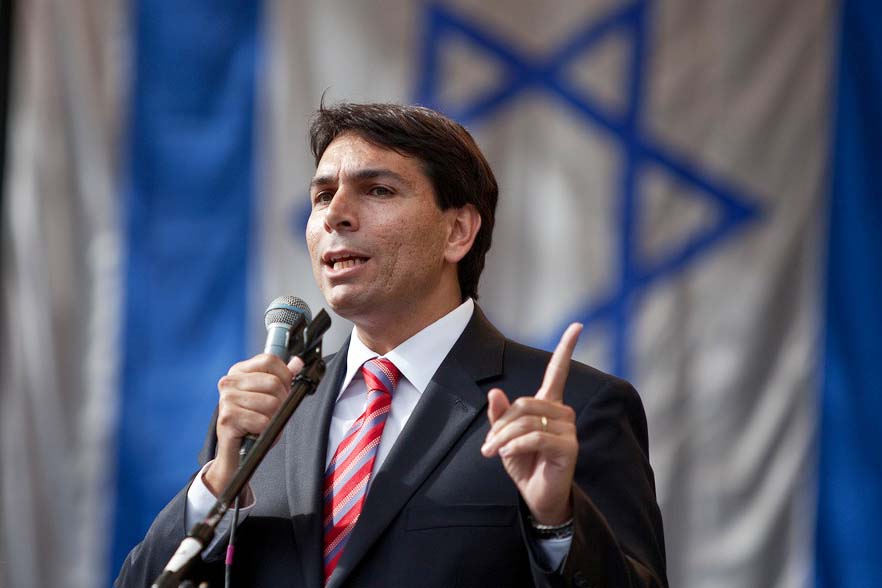
Danny Danon


A senior member of Netanyahu's right-wing Likud party, Danny Danon, accused Obama of seeking to destroy Israel by adopting the vision of the late Palestinian leader Yasser Arafat.

"Netanyahu only has one option: to tell Obama to forget about it," Danon said, according to Israeli media.

However, Obama's suggestion that negotiations should focus initially on territory and security, leaving the difficult issues of Jerusalem and the return of Palestinian refugees to a later date, appeared to chime with Netanyahu's own position.

Likewise, Obama's firm rejection of Palestinian moves to seek recognition of their statehood at the United Nations delighted Israeli officials. Abbas made no comment.

The Palestinians plan to pursue their statehood drive in September at the annual meeting of the U.N. General Assembly.

Peace talks between Israel and the Palestinians, brokered by Washington, collapsed last year when Netanyahu refused to extend a moratorium on Jewish settlement building in the West Bank and Abbas refused to carry on negotiations.

In Gaza, the Islamist Palestinian movement Hamas said Obama had no business criticizing the recent reconciliation pact between Hamas and Abbas's secular Fatah movement, intended to end a four-year split and produce a unity government.

"The peoples of the region are not in need of Obama's lectures," spokesman Sami Abu Zuhri said. "Obama reaffirmed his absolute support for the policies of the (Israeli) occupation and his rejection of any criticism of the Occupation."

"We affirm that Palestinian reconciliation is a Palestinian affair and that the (peace) negotiations have proven to be pointless," he said. "Hamas will never recognize the Israeli occupation under any circumstances."

Wednesday, May 18, 2011

The Breach of Israel's Golan Border


On Sunday, May 15, Israel's enemies breached three of its borders in an operation that caught its government, army and intelligence napping. Their reaction to the massive violation of its Syrian, Lebanese and Gaza borders showed all three to be muddled and incapable of an organized, rational tactical response to a multiple security crisis. This weakness, which was no doubted noted in Tehran, Damascus, Beirut and Ramallah, may be expected to lead to the next Syrian step to recover the Golan – not this time by thousands of civilians, but by military and terrorist forces.
Binyamin Netanyahu

Military sources report that the Prime Minister Binyamin Netanyahu, Defense Minister Ehud Barak, the chief of staff and his deputy, instead of dropping their routine occupations and taking charge of the crisis, preferred to make light of it. Local commanders, left to handle extreme situations developing at high speed during the day, were reluctant to assume responsibility for the weighty decisions called for.

This weakness, which was no doubted noted in Tehran, Damascus, Beirut and Ramallah, may be expected to lead to the next Syrian step to recover the Golan – not this time by thousands of civilians, but by tough military and terrorist forces.

Eleven months ago, Israeli intelligence missed the coming of the Turkish Mavi Marmara at the head of a flotilla for breaking the Gaza blockade. Israeli commandos who boarded the ship were therefore unprepared for the violence which met them.

The Israeli government and IDF did not learn from this incident. However, Syria, Hezbollah, Hamas and Turkey (which is preparing a second flotilla for next month) did and have adjusted their tactics to Israel's conspicuous shortcomings. The popular uprisings sweeping through Arab countries confirmed these anti-Israel forces in their conviction that massed civilians when wielded as a surprise weapon can achieve more than armies or individual terrorists. Crowds of civilians activated on several synchronized fronts are extremely difficult to withstand.
Tel Aviv thoroughfare

The coalition organizing the exceptionally violent events of the Palestinian Nakba (Catastrophe) Day Sunday, marking the founding of Israeli in 1948, first tested the water in the morning: An Israeli Arab drove his truck at high speed through a Tel Aviv thoroughfare, slamming into more than a dozen vehicles and running over pedestrians. He had killed one civilian and injured 17 over a 2-kilometer stretch of road before he was overpowered and apprehended.

When Israel's police chiefs declined to designate the attack an act of terror and insisted it could have been a traffic accident, Damascus, Hezbollah and Hamas felt they were safe in letting their master plan go forward: There was no risk of a tough Israeli response. And indeed, Prime Minister Binyamin Netanyahu later admitted that local commanders and police chiefs were directed to deal with all fronts "with maximum restraint while defending Israel's borders and sovereignty."

Military sources found this contradiction in terms perplexing hours after the IDF failed to defend Israel's borders and sovereignty against invaders.

Because of this directive, Israelis were shocked to discover at 13:30 that hundreds of Syrians, Palestinians and a Hezbollah group had crossed the border and hoisted Syrian and Palestinian flags in the main square of the Israel Golan village of Majd al Shams. They had already been there for four hours and no one was stopping them crossing the border back and forth during that time. Throughout the day, only a small squad of soldiers had been left to guard this border because nothing untoward had been expected there.

It was only at 17:00 hours that tanks and reinforcements arrived.

The invaders had every reason to march around the village declaring they had recaptured the territory Syria had lost 44 years ago while attacking Israel.


By then, military spokesmen had got their act together. It was fortunate that we undermanned the Syrian border, they said, otherwise the incident would have ended with hundreds of dead. The claim that Iran was behind the massive incursion convinced no one.

The Syrian interlopers were finally driven back across the border – not by Israeli troops – but by local Druze chiefs. Israel still does not know how many left and if any remained.
Israeli soldier Gilead Shalit


It is to be regretted that the IDF did not meet its fundamental duty to defend Israel's Golan border by bringing up large reinforcements to surround Majdal Shams, seal the Syrian border and shoot trespassers. The Syrians should not have been released but held until Damascus forced the Hamas to free the Israeli soldier Gilead Shalit.

Former Shin Bet director Israel Hasson, who is today an opposition Kadima lawmaker, commented later Sunday that Israel must make it crystal clear to Damascus, Hezbollah and Hamas that they will not be allowed to toss their internal problems into the Israeli court or violate Israeli sovereignty. His words fell on deaf ears, judging from the prime minister's statement.

Strategic sources fear that Israel will pay a heavy price for its flaccid response and misplaced "maximum restraint." Syrian President Bashar Assad can be counted on not to miss the chance of sending over to the Golan the Syrian and Palestinian terrorist teams he has held in reserve for more than a year for the right opportunity. That opportunity is clearly now at hand.

The Majd al-Shams invasion followed by violence by masked Palestinians in Jerusalem and a terrorist attack in Tel Aviv. It was synchronized with mass incursions from Lebanon and the Gaza Strip. This round is not over. It will not be stopped by military restraint.

Thursday, May 5, 2011

Hamas and Fatah defy Israel with power sharing deal


Israeli prime minister Benjamin Netanyahu


Benjamin Netanyahu attacked the reconciliation agreement as a "great victory for terrorism".

Speaking before a meeting with David Cameron in London, the Israeli prime minister also warned that the formation of a Hamas-Fatah coalition government in the Palestinian territories represented "a tremendous blow to peace". 

Nicolas Sarkozy

Mr. Netanyahu will carry the same message to Nicolas Sarkozy, the French president, when he arrives in Paris today as his right-wing government seeks to gain European support for sanctions against the new Palestinian leadership. But there was little to suggest that Mr. Netanyahu would have his way.

EU delegates joined officials from the United Nations and the Arab League at a ceremony in Cairo that brought the leaders of the two rival factions together for the first time since 2007.

Mahmoud Abbas

As ordinary Palestinians celebrated the reunification of the West Bank and Gaza, Mahmoud Abbas, the president of the Palestinian Authority and leader of the secular Fatah faction, pledged his commitment to making the reconciliation deal work.

"We announce to Palestinians that we turn forever the black page of division," he said. "We are certain of success so long as we are united."

Fatah and Hamas, its Islamist rival, fought a brief civil war in 2007 that left deep scars on Palestinian politics.

When it was over, the two components of the Palestinian territories effectively became separate entities, divided ideologically as well as geographically, with Gaza under Hamas control, with the West Bank in the hands of the Fatah-dominated Palestinian Authority.

European states, including Britain, have been cautiously welcoming of the reconciliation deal, accepting that unless Mr. Abbas could claim to speak for the 1.5 million people of Gaza as well as the larger West Bank, he had no real mandate to negotiate with Israel. Mr. Cameron was expected this evening to assure Mr. Netanyahu of Britain's continued support for Israel while at the same time urging him to view the wave of pro-democracy movements in the Arab world as an opportunity rather than a threat.

It is also hoped that Mr. Abbas can use his moderating influence to persuade Hamas to recognize Israel's right to exist, to abandon terrorism and to accept previous peace deals - three demands the international community says the group has to accept in exchange for legitimacy in the West.

Israel insists that such an outcome is unlikely and that Hamas will be strengthened by the agreement and could even use the West Bank to launch rocket attacks on its territory.

Mr. Abbas claimed that such arguments were being used by Israel as "a pretext to avoid negotiations" and insisted that the reconciliation deal would advance the peace process.

The Palestinian leader said he would not require Hamas as a party to recognize Israel but pledged that the new government would continue to and would also work to prevent all acts of violence against the Jewish state.

Khalid Mescal, the political leader of Hamas, also welcomed the deal, saying: "We have decided to pay any price so that reconciliation is achieved. Our real fight is with the Israeli occupier", (which really means "Attack at every opportunity).

Yet many observers think the reconciliation deal, seen as essential if Mr. Abbas is to win UN backing for Palestinian statehood in September, is unlikely to survive.

Many of the most contentious issues dividing the two factions remain unresolved, including the future of Hamas's military wing which is supposed to be incorporated into the Palestinian security forces - a step strongly opposed by the Islamists, who has the strong desire to annihilate Israel.

Committees have been established to address such outstanding issues and to prepare the way for presidential and parliamentary elections, which are meant to be held within a year under the terms of the deal.

Wednesday, April 20, 2011

Is Israel Being Set Up?


Q. Do you get the sense that Israel is being ‘set up’ to need to start a war next month with the Flotilla scheduled for May 14th, and all the constantly provoking rockets Gaza keeps sending? It seems like Iran, Hamas, Hezbollah etc are trying to force Israel to attack first, so they can have the excuse to fight back even harder, but not be the instigating ‘bad guys’ (even though we all know they are.) I just wonder if May will be the time that Isaiah 17 and / or Psalm 83 gets under way, and if you think that is likely.

I also wonder, and I realize we can’t know, if we will be here for it, or be summoned by Jesus before all the bloodshed starts. I pray daily, a few times a day actually, for ‘today’ to be the day He collects us. I can hardly wait to see Him in person, and never before now have I felt like it is so close. I very much appreciate your insight into this.

A. Yes I believe Israel is being set up. This will continue to be the case until they are officially back in their Old Covenant relationship with God. The Lord may even be using Israel’s enemies to accomplish this, since they don’t seem to be returning on their own. A number of qualified observers are talking about the likelihood of a spring war between Israel and its next door neighbors, so it’s not a far fetched idea.

We know the rapture could come any day now but so far no one has correctly predicted what that day will be so we’ll just have to wait and see.