Showing posts with label Libyan Crisis. Show all posts

Thursday, October 20, 2011

They're Dropping Like Flies; Take A Bow, Moa


Officials in Libya's transitional government said Muammar Gaddafi has been killed in the fall of his hometown Sirte earlier today. But there was no official confirmation from the country's most senior leaders.


Information Minister Mahmoud Shammam said he has confirmed that Gaddafi was dead from fighters who said they saw the body. 
Minister Mahmoud Shammam


He said he expects the prime minister to confirm the death soon, noting that past reports emerged 'before making 100 per cent confirmation.' 'Our people in Sirte saw the body... Mustafa Abdul-Jalil will confirm it soon,' he told The Associated Press. 


'Revolutionaries say Gaddafi was in a convoy and that they attacked the convoy.' Colonel Roland Lavoie, spokesman for Nato's operational headquarters in Naples, Italy, said the alliance's aircraft on Thursday morning struck two vehicles of pro-Gaddafi forces 'which were part of a larger group maneuvering in the vicinity of Sirte.' But Nato officials, speaking on condition of anonymity in accordance to alliance rules, said the alliance also could not independently confirm whether Gaddafi was killed or captured.
The spokesman for Libya's transitional government, Jalal al-Gallal, and its military spokesman Abdul-Rahman Busin said the reports have not been confirmed.
The caution in making a definitive announcement came because past reports of Gaddafi family deaths or captures have later proven incorrect, even after they were announced by officials, because of the confusion among the revolutionary forces' ranks and the multiple bodies involved in commanding their fighters.


For Barack Obama and his national security team, the simultaneous fall of Sirte and the death of Muammar al-Qaddafi provide an important punctuation mark in their successful initiative to support Libyan rebels and bring an end to an odious dictatorship.
The political benefits that accrue to the president at home will be modest. Domestic issues command the attention of American voters. What's more, the president's Republican opponents don't want to talk about the war on terroris very much. And with good reason. The president's record is for the most part too good to take issue with.
The president came into office promising to get the United States out of a disliked war in Iraq and has kept the promise. He came in promising to shift the focus to Afghanistan and finishing the business of decapitating al Qaeda. He did both. Bin Laden is dead. And we are committed to coming home from Afghanistan, too. While the administration's response to the first stirrings of rebellion in the United States, Occupy Wall Street, Restoring relations with our European allies, engineering the "pivot" in priorities to Asia cited by Secretary of State Clinton, and the recognition of the growing importance of dealing with emerging powers are all developments that are going to determine his chances of re-election.

But more important than any political benefits that accrue to the president as a result of this successful outcome to the Libya effort is that it brings into focus an important shift in U.S. national security strategy, a doctrine that stands alongside Clinton's "pivot" as one of the signature contributions of Obama and his security policymakers. Indeed, although I am reluctant to throw around the term "doctrine" because it has become devalued through overuse, I believe it puts into focus what can and should be identified as the Obama Doctrine, which we've all seen to mean, "Kill all terrorist threats".


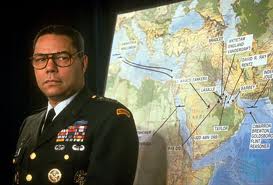
General Colin Powell
This doctrine stands in contrast to the famous doctrine named for General Colin Powell. Powell's approach turns on the idea that prior to military action being taken by the United States; we must first exhaust all other means of advancing our national interest and then when we engage that we use every available means to achieve clearly defined goals and thus be able to execute a reasonable exit strategy.
This approach was, more than anything else, a reaction to the problems the U.S. encountered in Vietnam and the "every available means" or "overwhelming force" element was clearly a manifestation of a deep pockets view of U.S. resources that now seems like the quaint echo of a bygone time.


The New Obama Doctrine
The Obama Doctrine, while also grounded in the idea that we must exhaust every other means of advancing our national interest, is responding to the lessons of a different unpopular war, in this case, Iraq. It is a reaction against the use of "overwhelming force" to achieve rather narrow (not to mention dubious) goals. It is an antidote to "shock and awe," "three trillion dollar wars" and unilateral conventional invasions if they can possibly be avoided.
Whereas the Bush administration engaged in an open checkbook approach to a global "war on terror" (a perversion of the Powell doctrine that was especially uncomfortable for Powell himself to watch unfold), Obama's approach -- in fighting terror, getting Bin Laden, assisting with the ouster of Qaddafi, and elsewhere -- has been not only to cast aside the term "war on terror" but also the strategies and tactics of massive ground war.
Obama & Co. embrace the orthoscopic alternative to the open heart surgery favored by the Bush team. The Obama Doctrine prioritizes the use of intelligence, unmanned aircraft, special forces, and the leverage of teaming with others to achieve very narrowly defined but critical goals. That word leverage is the key. It is about using technological superiority, effective intelligence, surprise, and smart collaboration to make the most of limited resources and do so in a way that minimizes risks to both personnel and to America's international standing and our bank account.


"Leading from behind" is an important element of this doctrine. It is no insult to lead but let others feel they too are architects of a plan, to lead without making others feel you are bullying, to lead but do so in a way in which risks and other burdens are shared. Libya is a test case for this approach. It too started ugly and there are many lessons to be learned by NATO and the United States about how to do this better. Our communications around the time of undertaking the involvement were also handled in a ham-fisted manner. No matter. Most of that will be forgotten now. Outcomes matter most and the outcome here has been low-cost and high-reward.


More importantly, perhaps, it solidifies an Obama approach to meeting international threats that seems better suited to America's current capabilities, comparative advantages, political mood and the preferences of our allies everywhere than prior approaches which were created in and tailored to far different times.


Let's See; Who's Next


Thursday, August 25, 2011

Where's Moa?

          Has anyone seen This Man? Moammar Gadhafi


He is nowhere to be found as his 42-year rule of Libya crumbles. Months of NATO air strikes have left his Bab al-Aziziya compound in Tripoli largely demolished. Most of his security forces fled or surrendered when rebel forces rolled into the capital Sunday night and took control of most of the city.  
Mohammed Gadhafi

Saif al-Islam Gadhafi
Rebels said that three of Gadhafi's sons had been arrested. But one report said that his eldest son, Mohammed Gadhafi, was reported to have escaped Monday, according to the Libyan ambassador to the United States.Saif al-Islam Gadhafi, who is wanted on war crimes charges by the International Criminal Court in The Hague, had been reported captured on Sunday along with two of his brothers. Luis Moreno-Ocampo, the ICC's chief prosecutor, had said Sunday that he would seek Saif al-Islam Gadhafi's extradition following his capture. But Saif Islam turned up early Tuesday morning at the Rixos hotel, where about 30 foreign journalists are staying in Tripoli under the close watch of regime minders. He then took reporters in a convoy of black, armored SUVs on a drive through parts of the city under the regime's control. Asked about the warrant for his arrest, Saif al-Islam told reporters, "To hell with the ICC." 
M.C. Moa, rappin' in L.A 

"The real moment of victory is when Gadhafi is captured," Mustafa Abdel-Jalil, head of the rebel National Transitional Council, told a news conference in the opposition's de facto capital of Benghazi, hundreds of miles east of Tripoli. He said the rebels have no idea where Gadhafi is and whether he is even in Tripoli. An Obama administration official said the U.S. had no indication that Gadhafi had left Libya.

The official said U.S. officials and NATO partners had not been in contact with Gadhafi during the siege on Tripoli. However, the official said U.S. and NATO representatives, as well as Libyan rebels, had been in contact with people around Gadhafi, mostly those looking for a way out.
Back stage at Gadhfi's concert in L.A


Scuds Away
A mood of joy mixed with trepidation settled over the capital, with the rebels still fighting pockets of fierce resistance from regime loyalists firing mortars and anti-aircraft guns. Rebel spokesman Mohammed Abdel-Rahman, who was in Tripoli, said the "danger is still there" as long as Gadhafi remains on the run.


Gadhafi's forces remained active, firing off a short-range Scud missile Monday near Sirte, Gadhafi's hometown and one of the few remaining cities still under his control, said U.S. military officials, who spoke on condition of anonymity to discuss military operations. It was unclear where the missile landed or whether anyone was hurt.


NATO pledged to keep up its air campaign until all pro-Gadhafi forces surrender or return to their barracks. The alliance's warplanes have hit at least 40 targets in and around Tripoli in the past two days -- the highest number on a single geographic location since the bombing started in March, NATO said.
A day after the rebels rode into the city of 2 million, the situation remained volatile. Even though rebels claimed they were in control of most of Tripoli, they still appeared to be on the defensive, ducking for cover during frequent clashes with regime fighters. Throughout the day, the rebels sent reinforcements to the city from the north, south and southeast, and a rebel field commander said more than 4,000 fighters were part of the final push to bring down the regime.
Libyan commandos fighting Gaddafis forces came close to capturing the toppled leader on Wednesday when they raided a private home in Tripoli where he appeared to have been hiding, Paris Match magazine said  today. A unit which was coordinating intelligence services for Arab states and Libyan rebels, said on its website that these services believed Gaddafi was still somewhere in the Libyan capital.
Hiding out as one of Cherry Bombs boobs


The opinion is split as to whether the arrest warrants make a negotiated settlement with Gaddafi regime more or less likely. Colonel Gaddafi “personally ordered attacks on unarmed Libyan civilians,” in which armed forces shot demonstrators, fired heavy weapons on funeral processions and “placed snipers to kill those leaving mosques after prayers,” during the first weeks of the Libyan uprising, prosecutor Luis Moreno-Ocampo said. Mr. Moreno-Ocampo began investigating the situation in Libya after the United Nations Security Council referred the case to the court. The Court’s decision coincides with the 100th day of NATO operations in Libya.

As for Moa; He'll turn up somewhere, or he'll continue to pursue his budding career in the entertainment industry. So, We'll keep an eye out for you Moa.

Saturday, June 4, 2011

Free Africa from the Africans


The African Split


South African President Jacob Zuma
 As far as the United States and Europe are concerned, Africans have nothing to say about what happens in Africa. South African President Jacob Zuma made a second trip to Libya this week, on behalf of the African Union, seeking a diplomatic end to NATO’s war against Mouammar Gadahfi’s government. Just as with a previous African Union peace keeping mission, back in early April, Col. Gaddafi agreed to the peace plan. And just as before, the so-called rebels and their American and European bosses refused even to consider a cease fire. As has been obvious from the beginning of this “humanitarian” farce, the Great White Fathers of Europe and the “Wall Street mascot” from the United States, as Obama has been called, will be satisfied with nothing less than regime change in Libya – and to Hell with what Africans think!

The Euro-Americans will soon prove just as contemptuous of their erstwhile North African Arab allies, based in Benghazi, who claim to be leading a “revolution” against Gadahfi. But these rebels lost their legitimacy the second they decided to become the ground troops for a neocolonial invasion of North Africa. Revolutionaries fight the Power. The gang from Benghazi are mere pawns of imperialism and have no credibility whatsoever as revolutionaries. This is an imperialist war, fought for imperial objectives. The rebels have chosen to become imperialism’s mascots, waiting like pitiful little Gunga Dins for the British and French to arrive with attack helicopters to burn and kill their countrymen.

NATO orders their Libyan minions around like children. NATO recently “issued instructions” that the rebels not move beyond certain points in the desert, so as not to enter the killing fields that the rich white fathers – plus Obama – are preparing to incinerate Libyan government soldiers. Naturally, the rebels will do exactly as they are told, since this is not their revolution. Rather, Libya is the front line of the European and American counter-revolution. The chain of command reaches to Paris, London and Washington. Benghazi has reverted to the colonial outpost that it was when the Italians ruled – only now, in the 21st century, all of the Europeans plus the Americans get to lord over the Libyans, who grin and skin while thanking the colonizers for coming back to save Africa from the Africans.

And so it makes perfect sense that a peace proposal from the president of South Africa, Black Africa's most powerful and wealthy country, acting on behalf of the organization that includes every nation on the continent, counts for less than nothing in the imperial scheme of things. The West encourages South African President Jacob Zuma to help bring chaotic Black countries into line, but Zuma and the African Uni0n are not authorized to interfere with imperial wars on the continent. That's “white folks business.”

When the Western attack helicopters arrive, the Benghazi-based rebels will cheer, as if they won something. The Gunga Dins should carefully study those helicopters and their awesome firepower, because those guns will one day likely be turned against them. The U.S. and Europe have no intention of allowing Libyans to rule Libya. And after all, why should the imperialists hand over all that oil to a bunch of local flunkies who couldn't even fight their own war.

Monday, April 25, 2011

How Will the U.S. Get Out of Libya?


Call it the Goldilocks military plan: Not too much, not too little, not too unilateral, not too American. The operation against Muammar Gadahfi's regime in Libya mirrors the moderate temperament of its architect, Barack Obama. But will it work in the rough realities of international politics? That's the question that will be tested in the weeks ahead as high-tech images of cruise missiles and predator drones hitting their targets give way to a mess on the ground in Libya.

President Obama has launched an operation that has two distinct qualities, one highly unusual and the other familiar. At its broadest, Obama's diplomacy has tried to redefine the exercise of American power. It is an effort at a distinctive form of multilateralism, deeper than anything any President has tried before. At the same time, Obama is proposing a limited military intervention for a problem in which U.S. interests are limited. That's something Presidents in the past have promised but mostly been unable to deliver as events on the ground forced them to escalate for fear of being humiliated. However wise his multilateral instincts, it is how Obama handles this latter problem that will determine the mission's success — and duration.

So far, Obama seems to have pleased almost no one. For those who had been urging military action from the start, Obama dithered and remains too cautious. For those wary of another open-ended U.S. commitment in the Muslim world, Obama suddenly turned from restraint and became reckless.

But more than anything else, what appears to have infuriated many American politicians is Obama's unwillingness to put the U.S. in the driver's seat. "We have a Spectator in Chief instead of a Commander in Chief," fumed Newt Gingrich. Senator Lindsey Graham criticized Obama for acting as if "leading the free world is an inconvenience." And Rick Santorum levied the ultimate insult, noting that the French — the French! — had been leading the charge.

They are right, in part: Obama does not want to be seen as the ringmaster. The diplomacy of the past few weeks has broken a tradition born in the Cold War. For decades, U.S. Presidents unilaterally identified crises, articulated responses, determined actions and then persuaded, bribed and threatened countries to join in the "collective action." The U.S. ran the show with little interference from others but paid all the prices and bore all the burdens. Countries that would benefit from a military intervention rarely stood up to request it. They didn't need to. America would act, and they could free-ride.

Take a recent example. In the spring of 2003, George W. Bush refused both to give international inspectors more time to do their work in Iraq and to try to get a fresh U.N. resolution through, each of which he saw as an obstacle to attacking Iraq as quickly as possible. The result was a war that was tainted from the start, without a single Muslim ally and with few major countries invested in success. When things started going badly, criticism mounted; the U.S. was left in virtual isolation and, as Iraqi casualties piled up, was painted as the enemy of Arabs around the world.

America has always done better in the role of the reluctant imperialist. The simple fact is that the world does not like its leading military power to be overly eager to intervene in foreign lands. In fact, until the Cold War, the U.S. had a very different image from European great powers precisely because it had few expansionist impulses. America entered World War I after three years of bloody fighting just in time to tip the balance. It entered World War II only after Japan attacked it and Hitler declared war. The U.S. had the capacity to be an imperial power but chose not to be one. Yet during the Cold War, Washington developed the habit of intervening early and often in far-flung places, worried about communist takeovers. As a result, America was seen in much of the Third World in the same light as the European colonial powers, forfeiting a crucial moral and political advantage.

In the Libyan crisis, the Obama Administration made clear from the start that it was not enthusiastic about military action and would support it only if it were requested by the Libyan opposition and the Arab League — and with Europe doing much of the heavy lifting. This led to a remarkable turn of events in which on March 12 the Arab League officially requested that the U.N. impose a no-fly zone over Libya. This shift has not gotten the attention it deserves. In the 66 years since its founding, the Arab League has served as a shield for dictators and rarely produced anything but windy rhetoric about Arab solidarity and Palestine. The idea that it would act against one of its members — and because of human-rights violations! — was unimaginable one month ago. Five days later, the U.N. Security Council passed resolutions authorizing action against Gaddafi's forces. France and Britain were positively itching for military action.

Friday, April 22, 2011

Thanks N.A.T.O: Rebels Re-claim Misurata

Armed Predator drone


Today Libyan rebels claimed that they have recaptured the center of the besieged western city of Misurata, partly thanks to surge in NATO airstrikes, and said they hoped deployment of U.S. armed Predator drones could help them drive Moammar Gaddafi’s forces out of the city completely.

John McCain


 Further east, in the rebel stronghold of Benghazi, Sen. John McCain (R-Ariz.), one of the strongest congressional proponents of U.S. military intervention in Libya, made an unannounced visit to assess the situation for himself and called the rebels his heroes.


Rebels were buoyed by signs of progress in their military struggle against Gadahfi, seizing control of a border crossing with Tunisia near the country’s western mountains and, they said, reclaiming the center of Misurata.


Adm. Mike Mullen

 Adm. Mike Mullen, chairman of the U.S. Joint Chiefs of Staff, said coalition airstrikes have degraded Gadahfi’s ground forces by 30 to 40 percent but that the conflict nevertheless was “certainly moving towards a stalemate.”


In Misurata, though, the mood has lifted after weeks of increasingly desperate calls for more international help. Gadahfi’s forces seemed to be in disarray in Misurata, said Mohamed, a spokesman for the city council, who asked that his full name be withheld for safety reasons.

Misurata, Libya’s third-largest city 131 miles east of Tripoli, has resisted a Gadahfi counteroffensive for more than a month, becoming the last remaining rebel stronghold on Libya’s western Mediterranean coast.


“There is a general pattern of collapse everywhere,” Mohamed said, “According to our fighters, they [Gadahfi’s troops] seem to be acting like headless chickens, because their command and control has been disrupted by NATO.”
Libyan Resistance Fighters

Mohamed said rebels on Thursday cleared the last three buildings in central Misurata where government snipers had been operating, and he said the city was now “sniper free.”


The rebel account could not be independently verified, and Gadahfi’s government says it still controls 80 percent of the city. However, videos released by the rebels in Misurata showed their flags flying over pockmarked and charred high-rise buildings in the city, with fighters walking through streets strewn with glass and rubble, waving their hands in the air triumphantly and shouting Allahu Akbar (God is greatest).


Mohamed said the rebels had killed around 100 government soldiers in Misurata on Tuesday and scores since then. The rebels now control all of the city center and its main Tripoli Street, apart from a group of Gadahfi’s troops holding out in the main hospital who were surrounded and being asked to surrender, he said.


“I walked all the way down Tripoli Street myself this morning, all the way to the hospital,” he said. Mohamed and doctors in the city had expressed growing frustration with NATO in past week, but on Friday he said that if not for the alliance, Misurata would have been overrun a long time ago.

Libyan Rebel Flag Flies In Misurata


Mohamed said the rebels have secured the roads leading east and west of the city to prevent Gadahfi from sending in reinforcements but have not yet secured the road leading south to Bani Waled.


Residents in Misurata complain of water shortages and a lack of goods ranging from baby food to vegetables. They say electricity in the city has been cut off, forcing them to rely on generators. Thousands of stranded foreign migrant workers are awaiting evacuation in the port area.


There has also been intense fighting in the country’s remote western mountains in the past week, and rebels seized control of the border crossing to Tunisia nearest the area on Thursday. The government claimed that its military regained control of the border post later in the day, but witnesses said this was untrue, with the rebel flag still flying over the post on Friday.

Wednesday, April 20, 2011

France Vows to Step Up Airstrikes on Gadahfi's Forces

French Mirage over Libya


France vowed Wednesday to step up airstrikes on Libyan leader Moammar Gadahfi's forces and acknowledged that it has military officers already working with Libyan rebels on the ground.
French ordnanceman in Libya

Italy joined Britain in announcing their commitment of military instructors to train the rebels, who have failed to rout Moammar Gadahfi's forces despite weeks of NATO-led airstrikes.

European powers and the Libyan opposition remained firm against sending foreign ground troops into Libya, a dangerous and politically risky step. However NATO, which is leading the U.N.-sanctioned international military operation to protect civilians, is now acknowledging that airstrikes alone cannot stop the heavy shelling of cities by Gadahfi's forces.

Gadahfi's forces attacked a mountain town and a besieged coastal city Wednesday, part of a drive to crush pockets of resistance in the western part of the country that is largely under the Libyan leader's control.

"France has placed a small number of liaison officers alongside our special envoy in Benghazi," French Foreign Ministry spokeswoman Christine Fages said in an online briefing Wednesday.

A French diplomat said the French officers are not combat troops and are not teaching Libyan rebels weaponry skills. Instead, he said, they are working on logistics and organizational help. France sent a diplomatic envoy to Benghazi earlier this month.

The diplomat, who spoke on condition of anonymity because of the sensitivity of his operation, would not say how long the officers have been in Benghazi.
Nicolas Sarkozy

Francois Baroin
 French government spokesman Francois Baroin suggested less than 10 officers were involved and insisted the move conforms to the U.N. resolution authorizing the international military campaign in Libya.

France has championed the international campaign in Libya. President Nicolas Sarkozy met Wednesday with visiting Libyan opposition leader Mustafa Abdel-Jalil, who said he asked France "to intensify the support accorded to the Libyan revolution."
Mustafa Abdel-Jalil

"We will intensify the strikes," Sarkozy responded, according to a presidential aide. The aide was not authorized to be publicly named according to presidential policy.

"We will help you," Sarkozy promised his Libyan visitor.

A NATO official said there had been no pressure from France to increase allied strikes, but that France might increase its own contribution. The official was not authorized to be publicly named.


Ignazio La Russa
In Rome, Defense Minister Ignazio La Russa said 10 military instructors will be going to Libya to help the rebels, but again ruled out sending Italian ground troops.

La Russa spoke after meeting with British Defense Secretary Liam Fox, who said many of the Libyan rebels "have no military experience, they have little understanding of weaponry or military tactics."

"The best way in which we can assist them is to give them some technical capabilities in how to organize themselves," Fox said.

The British minister said the situation was "not that different from what's happening in Afghanistan, where we've decided that training up security forces so that the Afghans themselves can look after their own security is the best way forward."

Britain said Tuesday it was sending up to 20 military advisers to help Libya's rebel forces.

A spokesman for Libya's National Transitional Council, the political wing of the rebel movement, said Wednesday the military advisers would be a big help.

"My understanding is that it will all be administrative help, nothing with weapons and nothing in the field," Mustafa Gheirani said.

The rebels have repeatedly said they do not want foreign troops on the ground.

French Defense Minister Gerard Longuet suggested the U.N. Security Council should weigh whether to send ground troops. "It's a real question that merits international reflection," he said after a Cabinet meeting Wednesday.

Abdel-Jalil insisted that the ragtag rebel force and fledgling opposition governing council would respect international norms if they emerge victorious in their battle with Gadahfi, who has ruled Libya for 42 years.

"We will work to build a democratic state where the chief of state arrives in power not on a tank, but by a ballot box," he said. "We are also committed to working to fight terrorism and stop illegal immigration."

Tensions over waves of illegal migrants from North Africa entering Europe in recent weeks have strained relations among European neighbors and clouded the international campaign in Libya.

NATO's top military commander, U.S. Navy Adm. James Stavridis, was in Prague for talks with Foreign Minister Karel Schwarzenberg on Wednesday and Defense Minister Alexandr Vondra on Thursday. Stavridis' visit comes as NATO is seeking military contributions from member states that have not participated in the campaign in Libya, like the Czech Republic.

Monday, April 18, 2011

Libya: A new phase in the conflict


The Libyan city of Misrata, besieged by government forces since the outset of this conflict, is a symbol of the rebel forces' tenacity, and of the inadequacy of NATO's strategy.

Indeed, Misrata is fast becoming the anvil on which the Atlantic Alliance's whole policy could falter.

Western air power turned advancing Libyan government forces back from Benghazi at the outset of this campaign; a quick success story, hailed by participating countries as justification for the decision to intervene.

But now, some four weeks on, Libyan government pressure on Misrata, a city of some 300,000 people is, if anything, growing.

The claim by Human Rights Watch over the weekend that Libyan government troops were firing cluster munitions into civilian areas - denied in Tripoli - gives added urgency to the city's plight.

Air strikes around Misrata's outskirts have served to keep Col Gadahfi's troops at bay, but only just.

They have infiltrated the city, parking their armored vehicles in among buildings, making them harder to hit without risking civilian casualties.

If anything, Misrata illustrates once again the limitations of modern air power.

Whatever politicians may think, it cannot win conflicts on its own. It is a decisive factor but must be employed along with effective forces on the ground. That is precisely what is lacking on the rebel side in Libya.

Nato aircraft have also struck at Libyan government vessels in order to keep open the tenuous maritime access to the city.

It is this maritime link that is now the focus of discussions in New York, with urgent efforts under way to bolster the volume of humanitarian aid going into the city.

But the sea route out has also been vital for the evacuation of casualties and there are growing fears for large numbers of migrant workers who find themselves stranded in a war zone.

So in a sense one phase of this conflict is over. Colonel Gadahfi's forces have weathered the storm. His regime has not collapsed.

Nato warplanes have contributed to an enforced stalemate in the east, but the inadequacies of the rebel forces mean that they are unable to defeat their government opponents on the ground.

After a hectic series of diplomatic meetings over the past week there seems to be a general sense that something more must be done, But what? None of the options are quick or simple.

1. Nato boots on the ground:

Military experts believe that a relatively limited force of well-trained western troops might make a significant difference. But Nato leaders appear unwilling to countenance the use of ground troops, constrained by the terms of UN Security Council resolution 1973 and concerns about how this would look both to Arab opinion and their own publics at home.


2. Equip and train:

The focus may shift to providing training for the rebel forces. Qatar for one has signaled it is willing to pay, but who exactly might provide the expertise required remains an open question.

Training takes time. What the rebel forces need badly for example are low-level commanders able to conduct basic fire and movement manoeuvres. These skills cannot be learnt, and more importantly employed, overnight.

Reports from Benghazi suggest rebel forces are already beginning to get some arms shipments, though their scale and content is unclear.


3. Advice and support

Another option, linked with "equip and train" would be to have outside experts or advisers on the ground alongside rebel forces. They could provide key coordinating skills which might also increase the effectiveness of Nato air-power. But here too the question is: where would they come from?

The crisis in Misrata gives added urgency to all these questions.

Friday, April 15, 2011

Gadahfi Troops Fire Cluster Bombs Into Civilian Areas


 Cluster Bombs Unit


Military forces loyal to Col. Muammar el-Qaddafi, who have surrounded this city and vowed to crush its anti-Qaddafi rebellion, have been firing into residential neighborhoods with heavy weapons, including cluster bombs that have been banned by much of the world and ground-to-ground rockets, according to the accounts of witnesses and survivors and physical evidence on the ground.

Such “indiscriminate” weapons, which strike large areas with a dense succession of high-explosive munitions, by their nature, cannot be fired precisely, and when fired into populated areas place civilians at grave risk.


The use of such weapons could add urgency to the arguments by Britain and France that NATO needs to step up air attacks on the Qadahfi forces, to better fulfill the United Nations mandate to protect civilians. And it could place pressure on the United States, which pulled back air power from the war when it ceded control of the campaign to NATO earlier this month.


When asked about the weaponry at a news conference in Berlin, Secretary of State Hillary Rodham Clinton said she was “not aware” of the specific use of cluster munitions in Misurata, but said, “I’m not surprised by anything that Colonel Qadahfi and his forces do.”

A Cluster Munition Victom
 She added: “That is worrying information. And it is one of the reasons the fight in Misurata is so difficult, because it’s at close quarters, it’s in amongst urban areas and it poses a lot of challenges to both NATO and to the opposition.”


The cluster munitions were visible in use late Thursday night, in the form of what appeared to be 120-millimeter mortar rounds that burst in the air over the city, scattering high-explosive bomblets below.

Remnants of expended shells, examined and photographed by The New York Times, show the rounds to be MAT-120 cargo mortar projectiles, each of which carries and distributes 21 smaller submunitions designed both to kill people and penetrate light armor.
Components from the 120-millimeter rounds, according to their markings, were manufactured in Spain in 2007 — one year before Spain signed the international Convention on Cluster Munitions and pledged to destroy its stocks. Libya is not a signatory to the convention, and neither is the United States, which used the weapons in Iraq, Afghanistan and, in 2009, Yemen. The Spanish Defense Ministry had no immediate comment.
Human Rights Watch, the New York based advocacy group, verified the use of the cluster munitions as well, and swiftly called on the Qadahfi government to stop using them.
“It’s unconscionable that Libya is using these indiscriminate weapons, especially in civilian populated areas,” said Steve Goose, director of the organization’s arms division. “Cluster munitions are inaccurate and unreliable weapons that by their very nature pose unacceptable dangers to civilians.”

GRAD Rocket
The cluster munitions are not the only indiscriminate heavy weapon system to imperil the city’s neighborhoods. An examination of the area of an intensive rocket barrage on Thursday near the city’s port showed that the Qasr Ahmed residential district was struck by multiple rockets, known as GRADs, which landed in a dense pattern on houses and streets. One rocket shattered the wall beside a mosque.
The GRAD rockets, an area weapons system designed in the Soviet Union to blanket a battlefield with multiple explosions, were readily identified by their twisted fragments and remains, some of which bore markings indicating they had been manufactured during the cold war. They are fired from truck-mounted launchers that hold 40 rocket tubes, so that each truck is, essentially, a mobile system that can launch its own barrage 12 miles or more.
One of the GRAD rockets alone killed eight civilians, according to survivors and witnesses, who then showed two journalists eight hastily dug graves in a public park nearby, where relatives prayed over the dead. The bodies had been interred beside two children’s swing sets. Each grave was dated: April 14, 2011.
Taken together, the attacks of Thursday and the evidence they left behind, point to a campaign by Colonel Qadahfi’s forces against Misurata that relies in part on weapons designed to endanger the lives of the civilians trapped within. They also support the rebels’ frequent contentions that in the lopsided fight for Libya, Colonel Qadahfi’s forces have targeted civilians or at a minimum, taken few measures to avoid endangering them.
“This is a human tragedy,” said Ali Salem, 40, a resident of Qasr Ahmed, who described his four children now struggling to sleep. “What else do you call it when they bomb with artillery, rockets and mortars people who are safely sleeping in their homes?”
The toll of the GRAD rocket strikes also framed the ways in which civilians in this war are forced into vulnerability. Misurata has few open markets, almost no electricity and limited supplies of food. To eat, many residents must stand in bread lines.
One of the rockets that landed in Qasr Ahmed exploded beside one of those lines, killing several people waiting for food. “I jumped onto the ground when the explosions started,” said Ali Hmouda, 36, an employee of the port. “My friend did not. His head came off.”

Saturday, April 9, 2011

Diplomats talk amid fierce fighting in key Libyan city

New Fighting In Libya

A battle raged in a strategically located Libyan city Saturday as state television showed a fist-pumping Moammar Gadhafi visiting a school, his first public appearance in days.


Rebels fought hard in a back-and-forth war for Ajdabiya, the last stop before their stronghold, Benghazi, further to the east. Witnesses reported three hours of fighting that they said involved explosions caused by NATO aircraft. NATO, however, denied any airstrikes in Ajdabiya Saturday.


As the sun set, the rebels appeared to have averted a major setback by maintaining control of the hard-won city -- but it was tenouous at best. Outgunned, they conceded they were facing a formidable foe.


In a hospital, witnesses told CNN that three of Gadhafi's fighters who were killed were carrying identification cards from Syria, Algeria and Chad.


Far from the battleground, African leaders meeting in Mauritania Saturday in an attempt to forge a mediator role in Libya's impasse.


The African Union's special committee on Libya -- represented by Mauritania, Congo Republic, Mali, Uganda and South Africa -- will then travel to the Libyan rebel stronghold of Benghazi to meet with the opposition leaders Sunday and Monday, according to the South African government.


The South African government also said NATO has granted the committee permission to meet with Gadhafi in the Libyan capital, Tripoli.


Gadhafi has been a big supporter of the African Union and has channeled large sums of money its way. Libya also holds a seat on the 15-member Peace and Security Council. As such, opposition leaders in Benghazi did not express optimism over the success of mediation.

The United Nations said Secretary-General Ban Ki-Moon will travel to Cairo, Egypt next Thursday to head meetings on Libya at the Arab League headquarters. Among the participants will be Catherine Ashton, the representative for foreign affairs and security for the European Union.

Meanwhile Libyan Foreign Minister Khaled Gaim condemned on state-run television the reopening of key ports in the eastern cities of Tobruk and Benghazi, which he said enables the rebels to resume an oil trade. He accused NATO of violating the United Nations Security Council resolution that mandates the protection of civilians.

State TV also aired images Gadhafi visiting on Saturday what appeared to be a primary school in Tripoli. The anchor said the school was a target of international airstrikes and was going to be attacked.

Former U.S. lawmaker Curt Weldon visited Libya this week hoping to speak directly with Gadhafi but left without a meeting. He did manage to secure a letter from the strongman to U.S. Secretary of State Hillary Clinton.

"I am disappointed that I did not get to sit down face to face with Colonel Gadhafi as promised, but I may have been able to get something even more significant -- a path to a resolution of this conflict," Weldon said in a statement on his departure.

Weldon visited Libya in 2004 when he was a Republican congressman from Pennsylvania and said he was invited this time by Gadhafi.

Any efforts at peace were a distant cry Saturday in Ajdabiya, where Gadhafi's forces attacked with a barrage of artillery fire at the city's western gates. Street fighting erupted as the loyalists, aided by sympathizers, entered the city and at one point, opposition fighters appeared to have all but lost again territory that was hard won.

At the height of their march toward Tripoli, rebels came within 40 kilometers (25 miles) of Sirte -- Gadhafi's hometown in western Libya. But loyalist forces have steadily pushed the rebels back and now stand poised to run down the highway to Benghazi, the opposition's capital.

Burnt carcasses of Libyan army tanks taken out by coalition aircraft three weeks ago litter the road. But it's increasingly harder to distinguish pro-Gadhafi troops. They have changed tactics and have taken to moving about in civilian vehicles.

"The troops of Gadhafi have good weapons and have training and have leadership and have experience," one rebel fighter said.

Thursday, April 7, 2011

Why France moved forcefully on Ivory Coast, Libya


With its aircraft in the skies of Libya and Ivory Coast, France has suddenly escaped diplomatic obscurity to find itself taking a leading role in two military ventures that have arguably tipped the scales on behalf of civilians.
Nicolas Sarkozy


This comes after France was embarrassingly late in embracing pro-democracy protests that successfully ousted its old allies in Egypt and Tunisia. French President Nicolas Sarkozy and his aides at the Élysée Palace have emerged from that diplomatic fumble to help engineer intervention in Libya and Ivory Coast and are showing a new, more robust international profile.

For France, the two military actions followed the same script. It moved swiftly after 11th hour United Nations resolutions authorizing "all necessary measures" to protect civilians and worked in tandem with other countries or multinational forces. And in both cases, reputedly unstable leaders appeared bent on blocking the people's will.

RELATED: Five key reasons Ivory Coast's election led to civil war

"In Libya and in Ivory Coast, France has played big. It is in the process, at least in Abidjan [Ivory Coast's capital], of scoring a success that will have a world impact," said military analyst Pierre Rousselin in the pro-Sarkozy daily Le Figaro.

French analysts are divided not on whether, but the degree to which domestic politics is motivating Mr. Sarkozy. He is making bold moves at time when his popularity at home is low. The UN resolutions have inspired in him a new determination to intercede in select crises that favor France’s military capability. France has long been known for “punching above its weight” on the global stage and doing so in a way that appears to bolster its international aims and French values and interests.

Sarkozy vowed when elected to restore a French international profile that had withered in opposition to the US-led Iraq war. The public here is generally opposed to operations in Afghanistan, where 4,000 troops are based, but appear to tacitly accept and even applaud action in Libya and Ivory Coast where France has a history and some notions of a sphere of influence.

“The French Army has the means of intervening at the same time in Ivory Coast, in Libya, and in Afghanistan,” says French air brigadier Jean-Vincent Brisset. But, he added, "It is obvious there are limits and that … multiple fronts can’t be sustained over long periods of time.”

Just as President Obama called on America’s “unique capabilities” to help a European request to intervene in Libya to save lives in Benghazi, Sarkozy has employed unique French capabilities in Ivory Coast, a former colony that has maintained French investment as well as military garrisons.

On Tuesday, France woke to find that French helicopter gunships hit former President Laurent Gbagbo’s forces just days after passage of UN Security Council Resolution 1975, which called for the use of French forces in an intervention in Ivory Coast. France's military action, which followed months of French neutrality, would seem to clear the way for elected president Alassane Ouattara to take office, and to avoid a civil war that was starting to spin out of control.

On March 19, Sarkozy ordered air strikes on Libyan targets, ahead of everyone, to stop a bloodbath in Benghazi. “The Arab peoples have chosen to liberate themselves from servitude in which they had been chained…. France has decided to take on its role before history … it is our duty,” intoned Sarkozy at the end of a Paris conference on Libya, even as French jets were in the air over the Mediterranean.

The French response was generally accepting, with even Sarkozy critic and leading intellectual Dominique Moisi calling it “the only way forward.”

In Ivory Coast, UN Secretary General Ban Ki Moon said the decision to involve France was “… a direct consequence of Mr. Gbagbo’s refusal to relinquish power and allow a peaceful transition … The country has been plunged into violence with a heavy toll on civilian population.”

Only in February France’s diplomacy was seen as in tatters. French leaders were tongue-tied as young people in Tunisia and Egypt lost their fear and upended long-time dictators. French diplomats had been caught on junkets with Egyptian and Tunisian autocrats; Sarkozy ordered his officials to vacation in France.

Meanwhile a cabal of current and former foreign ministry officials wrote a jeremiad: “Europe is powerless, Africa evades us, the Mediterranean steers clear of us, China tames us, and Washington ignores us! … the voice of France has disappeared in the world.”

In fact, France has always harbored significant power projection on the world stage; it has military bases across the Pacific and Africa, in far-flung former colonies, and it rivals or perhaps now exceeds that of Great Britain. France, unlike Britain, retains a carrier, and it has 10 submarines.

More than this, analysts point out, France’s robust moves allow Sarkozy and France to “break out” of a recently diminished sense of itself as a junior partner in Europe to Germany and Chancellor Angela Merkel. Germany doesn’t project power overseas, but France can. There’s a powerful strain among French who feel their country has a role in bringing European values to the larger world.

Internationally, "we hadn't seen much happening from the German side," says Davis Lewin of the Henry Jackson Society in London, "and the French are saving lives."